The Art of Verbal Behavior and Telemarketing
Ancient Art and Verbal Behavior
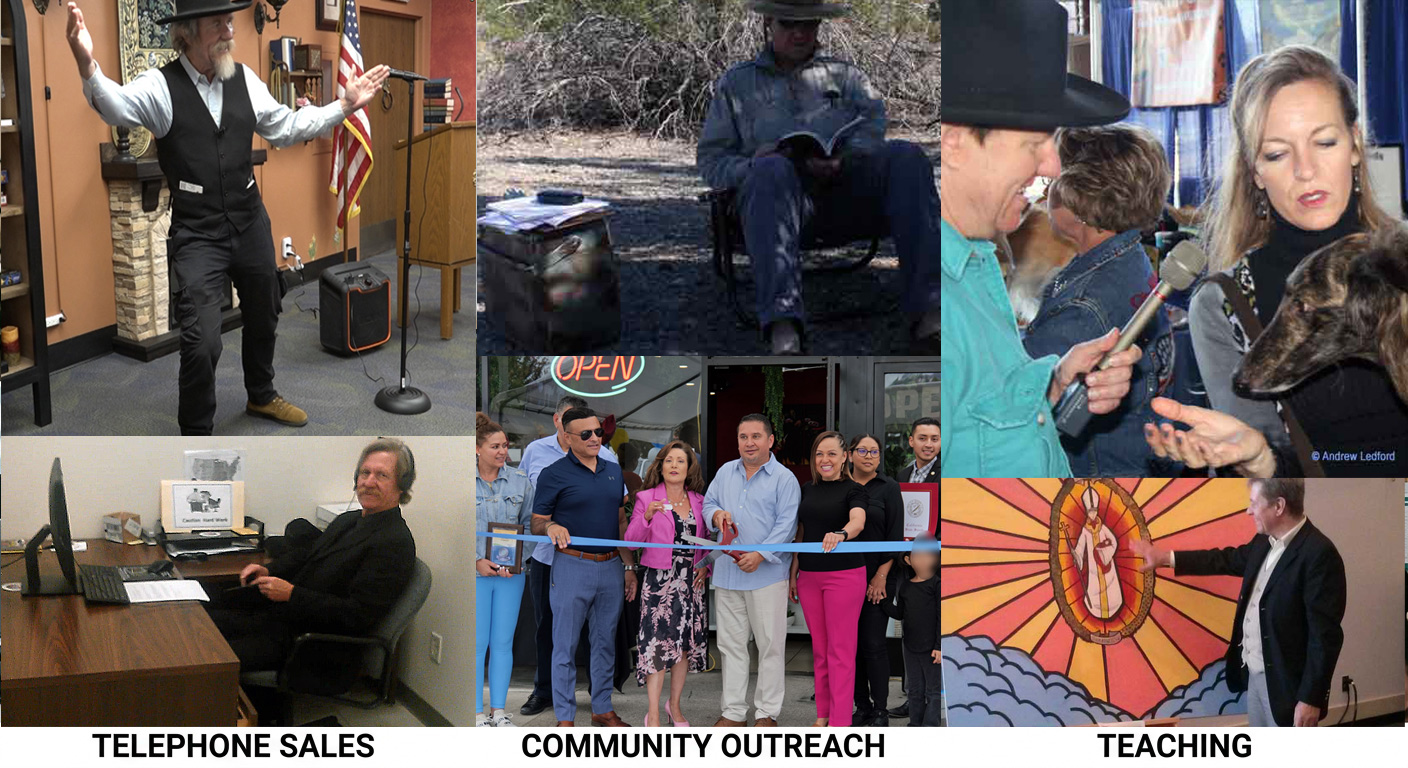
What does a 67,800-year-old Indonesian hand stencil have to do with telephone sales, community outreach, public speaking, writing, presenting on-camera, and teaching? They are all ways to communicate to an audience. They are all forms of verbal behavior.
Verbal Behavior is a very complex subject that touches on what it means to be human.
By looking at ancient artifacts we see it has been evolving for over 67,800 years and most likely longer. The earliest art we know of, or at least the beginning of art, is a zigzag engraving on a shell from around 500,000 years ago. It was not created by modern humans, but by Homo erectus. I speculate that this proto-art most likely had not yet develop any real cultural meaning. But I suspect it did serve as the foundation for how art developed into a language with meaning. I think of this much like how, according to archaeologist Denise Schmandt-Besserat, clay accounting tokens used inside of clay envelopes in ancient Mesopotamia eventually became cuneiform. Cuneiform and Egyptian hieroglyphics are the earliest writing systems we know of. Neanderthals may also have created art. A hand stencil in Spain has been attributed to them, though the dating of it is debated. While only speculation, it’s likely that not just big brained modern humans, but other more ancient forms also developed art as a form of communication. Art that served as a form of verbal behavior.
A note on terms. I am using “verbal behavior” broadly. B.F. Skinner introduced the term in 1957 with a more precise meaning, behavior that is reinforced through the actions of another person. Art and speech both fit this description. While I may apply it more broadly or out of the original context of behaviorism, I am influenced by Skinner’s 1957 work.
We will be exploring verbal behavior from many angles. Some may be more technically correct, others more in line with a cultural explanation and still others more narrative or story based. While behaviorism and neuroscience may be more precise, they don’t always translate into easy to apply techniques. This article will be added to as I have time to work on it. In the process it may also change in emphasis from or to different theories and/or practices.
First, we look at high stress forms of verbal behavior in phone sales and lead generation.
I want to explore phone sales first. As this page develops, I also plan on talking about face-to-face lead generation and public speaking.
Phone Sales and Telemarketing
I am going to use phone sales to begin with because many people find this a highly aversive job, and turnover gives us a way to measure how aversive it is. Public speaking does not have a comparable measure. It also makes for an interesting comparison between two types of verbal behavior that the majority of people find undesirable.
We need to start by determining what is and isn’t so. A lot of verbal behavior statistics are most likely inaccurate and can be accounted for by sharpening and leveling (terms from Gordon Allport and Leo Postman’s research on rumor), misquoting, or simply made popular because they sounded plausible, but never substantiated. I searched for statistics on the fear of phone sales and public speaking and found very little solid research. A lot of the research on phone sales was from companies that had a financial incentive to sharpen (exaggerate) statistics in their favor. They are also probably in the best position to gather data.
Here is what I found from Ringly. The sources for these stats are cited. However, they happen to be other companies selling a solution. I could not tell whether these companies are independent of one another.
Call center turnover averages 40-45% annually in 2026, and high-stress sectors reach 55-60%. That’s the suggested baseline businesses need to plan around. (Insignia Resources)
My observation.
Jobs that I have held would agree with the higher number. I have not done this enough to make that statistically relevant.
Call center turnover is more than double the average across all other occupations. This makes it a structurally different retention problem. (Insignia Resources)
My observation.
This is a tough job many people hate and it creates a great deal of negative emotional responses. I have always extrapolated the research of Pavlov, and later Wolpe, about what was called experimental neurosis as a condition of phone sales and some in person sales.
Average call center agent turnover was 35% in 2021 and 38% in 2022. The trend has been creeping up. (SQM Group)
My observation.
This is interesting and I have no comment.
First-year attrition rates of 69-73% mean most turnover happens within the first 12 months. You lose most people before they ever become fully productive. (Insignia Resources)
My observation.
From my experience I would agree with this. After 12 months workers experience undesirable management practices or find a job with better pay.
Average agent tenure is just 14 to 15 months across the industry. By the time someone’s genuinely good at the job, they’re already close to leaving. (Insignia Resources)
One benchmark puts average agent tenure at 14.3 months. Different sources, same story: barely over a year. (Bright Pattern)
My observation.
I think this is true. But it can be influenced by better trained managers and better pay. I think most people who leave and have the needed traits for doing the job leave because of bad management or low pay.
One company I talked with about recruiting and training callers had very high turnover. The hiring manager told me they kept people in the job by encouraging employees to take on new debt, so they would have to keep working and could not afford to quit. I was told I should plan on how to do the same. I thought it was an unscrupulous practice. I did not work for that company.
Burnout and stress behind the turnover. The job is genuinely draining, and the data on stress indicates this.
87% of call center agents report high or very high workplace stress. Almost nobody in the role describes it as low-pressure. (HiveDesk)
My observation.
I have noticed even experienced and successful call agents are often under stress. They display more or less displacement behavior. Displacement behavior is a term from ethology, associated with Niko Tinbergen. It means an action that looks irrelevant to what the animal is doing, such as scratching, grooming, or fidgeting, that shows up when there is a conflict and the individual is experiencing some kind of stress. In callers I have observed many of the same behaviors I see in dogs: displacement vocalizations, drinking, limb movements, such as excessive foot movements or unnecessary hand movements, getting up and down, and what could be classified as displacement grooming. But people who are going to quit usually display a great deal more displacement behavior, sometimes from day 1. I have mostly worked in either a job requiring complex technical knowledge or to know where to find it, trade show marketing for a promoter that businesses didn’t want to work with, or where the person being called is experiencing high levels of emotional distress and uncertainty, while getting bombarded with sales calls. I think this increases the stress and pressure on the call agents, and I then have the opportunity to observe some interesting behavior.
That stress bleeds into personal life for 77% of agents. They don’t clock out at the end of a shift. (HiveDesk)
My observation.
I have not noticed excessive stress after work in the people who handle the job and mental stress well. Those who have a hard time managing the negatively emotionally charged conversation most likely do. But people do take the work home with them. On their off time they do tend to work at learning how to improve their performance and how to become more skilled.
74% of call center workers currently report high burnout. Three in four is the norm. (HiveDesk)
53% of high-stress agents say they’re likely to leave within six months. Burnout and turnover are the same curve, just measured at different points. (HiveDesk)
Employees who are very often or always burned out are 63% more likely to take a sick day, per Gallup. That figure comes from Gallup’s research on full-time U.S. employees in general, not call centers specifically, but it shows how burnout drives daily absence.
My observation.
For someone to work in this field they need to develop a personal strategy of how they will deal with the stress. I think we can learn a lot about developing this strategy from authors who take very different approaches to the subject. First would be a swordsman and duelist, Miyamoto Musashi, the second would be a neuroscientist, Antonio Damasio. Another strategist to consider is John Boyd. This is for the one doing the calling. We need to add to this list if we are talking about the managers overseeing the callers.
First, I want to go over Claude Shannon’s technical aspects of communication because this is relevant for phone sales in particular, but it applies to all forms of verbal behavior.
The Basics For Communication Theory.
- Information Source: The entity or device that selects and produces the desired message to be sent.
- Transmitter (Encoder): The mechanism or equipment that transforms the raw message into physical signals (such as electrical currents, radio waves, or digital bits). In our case the phone rep.
- Channel: The medium or physical path (such as a copper wire, fiber-optic cable, or free space) used to carry the signal from the transmitter to the receiver.
- Noise: Unwanted physical or electronic interference (such as static, distortion, or signal degradation) that alters or disrupts the signal during transmission. For this example we will also include office noise. If your people work in a noisy call center it introduces noise into the call as well as increasing the rep’s cognitive load, which acts as mental noise. The same is true for the one receiving the call.
- Receiver (Decoder): The device or mechanism that intercepts the signal from the channel and translates it back into a usable message form.
- Destination: The final target equipment or person that receives the reconstructed message.
What everyone who works the phones needs to ask is, are we adding unnecessary noise into the conversation? We need to consider both technical noise and semantic noise.
The distinction between technical and semantic noise comes from Warren Weaver’s section of The Mathematical Theory of Communication (Shannon and Weaver, 1949). Weaver described three levels of communication problems: technical, which is how accurately symbols are transmitted, semantic, which is how precisely they convey the intended meaning, and effectiveness, which is whether the received meaning leads to the desired behavior.
I write about how Claude Shannon’s communication theory affects communication between the handler and dog in my book Dog Training, Strategies, Tactics, and Personal Insight. This is Dog training Tip 54, Become aware of the noise to signal from Communication theory starting on page 130. The same principles apply with human to human communication.
Next we will look at how different approaches to what I call verbal behavior influence performance and audience acceptance. Some that I am interested in are Skinner, Richard Bauman (Verbal Art as Performance, 1977), Musashi, Damasio, and Boyd. All of these can influence and inform the strategy of the person making the calls.
I may need to move this section to its own post in the future.
These are general rules or nomothetic theories that can be applied across much of human behavior. But here we are concerned with verbal behavior in particular.
B.F. Skinner’s Science Of Verbal Behavior
Let’s first look at is B.F. Skinner’s Verbal Behavior. It is worth noting that Skinner’s analysis of verbal behavior is often criticized by those favoring a traditional linguistic model. Skinner model is a rule base system built on his larger overarching ideas about how the contingencies of reinforcement shape and change behavior. I always have views this as selection based on incentives. Skinner looks at the reinforcing consequences, which also includes punishment. This is a sound theory and is used successfully helping children with autism. It can also be used just as successfully to teach verbal behavior patterns to professionals. Actually, the underlying theory can be used to teach all kinds of behavior. The first two areas of inquiry will be phone sales and face-to-face lead generation. Skinner’s theories are particularly useful in that they’re helpful for predicting and influencing behavior. They are also social and rely on a listener or audience that has a certain history.
Skinner views verbal behavior as behavior reinforced through another (person.) On a call the person being called is the other who reinforces. The prospect is the one who is primarily despising reinforcement and aversives (punishment). Although a manager can also do this and may have an even greater affect on long term performance.
We also need to consider that the rep is also the listener or audience to the one being called.
There are several verbal operants we can explore.
First, we’ll look at the mand. This neologism Skinner created has some of the properties of “command,” “demand,” “countermand. A mand is controlled by what the speaker wants and will usually “specify” what that want is. mands are typically for the benefit of the speaker. An example is “Can I get a few minutes of your time?” When the prospect becomes the speaker, it may take the form of “Take me off your list.” mands are for the benefit of the speaker. For this reason, repeated mands are often considered aversive and get some kind of escape behavior or aggressive response from the listener. Another form of repeating mands is when several callers contact a prospect for the same reason. Ten callers all manding the same class of behavior often get an emotional response that leads to hostility and escape. The mutiple callers all manding (demanding) the same thing are added together into one class of aversive social interactions to be avoided. Multiple solicitation calls also add noise into the cognitive channel of the listener. The multiple calls creating aversive emotional responses combined with multiple, often deceptive manding, contribute to the summation of the events into something that may or may not be there. Multiple manding callers then leads to a more sever negative verbal response on the part of the prospect. It is common for telemarketers to learn how to soften or conceal mands by disguising them as another type of verbal behavior.
Next, we look at the Tact. The tact is another word Skinner created to use for a special meaning. In his 1957 book he indicates the tact was developed to describe verbal behavior which “makes contact with the physical world.” This is naming something in the world and includes describing events. The something could be a product’s features or an event, such as the prospect’s situation. Sales trainers often disguise mands as tacts. Skinner describes this as a type of mixed control.
For the type of verbal performance we’re exploring Self-Tacts are important for performing the job and for improvement. Most people in the general population would know this as self-Talk. The Self-Tact is a necessary part of feedback that influence future behavior. The next call for phone reps, the next presentation for face-to-face lead gen, or the next public talk for the speaker.
Intraverbal behaviors are responses to someone else’s words, like small talk (phatic communication) and objection handling. Intraverbals also include known facts and memorized behavior, like a speech or presentation. Most trained verbal presentation skills involve this kind of behavior. One purpose of training is to improve the reps intraverbal responses without slow thinking. Here the speaker as listener will implement automatic correction of his behavior once a trained sequence in in some strength. We also see this when teaching people psychomotor skills, they self-monitor their own behavior and can self-correct after a poor performance. Sales and marketing people do this a lot. The quality of intraverbal behavior a professional presenter makes often depends on their skill level and how new they are to the job. Those new to this kind of work need to regulate just making the next call or presentation. Making the next presentation often uses both the Self-Tact (self-talk) and intraverbal behavior. More experienced individuals need to modify their verbal behavior in other ways. The next stage usually takes on aspects of Deming’s Plan-Do-Study-Act cycle. Once the knowledge and proper behavior is in sufficient strength the response should start using something closer to John Boyd’s OODA Loop.
The more interesting question for our purposes is how to effectively teach someone and/or learn intraverbal selling behavior that will be effective when it’s needed?