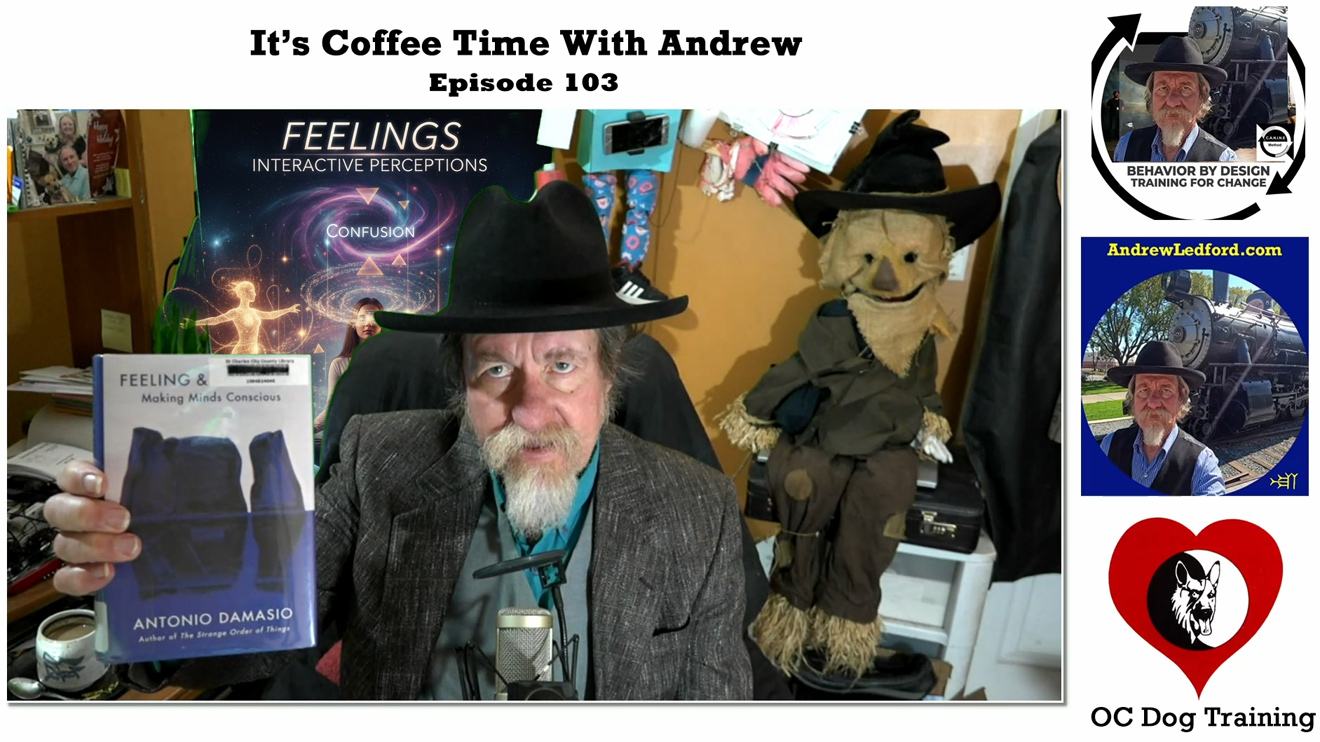
Coffee Time With Andrew 2.0 Episode 103 Book Reviews
In this video I talk about three book I have recently read. One I found interesting but I don’t think is for most people. The first book’s title is “Feeling and Knowing” by Antonio Dimasio’s. The second book is a very popular book that I did not like “The 7 Habits of Highly Effective People.” and the third book explains why I did not like The 7 Habits of Highly Effective People and that book is “How We Know What Isn’t So”
Here is the automatic transcription.
Good morning, I’m Andrew Ledford and this is another episode of It’s Coffee Time with Andrew, episode 103.
And today, well, last time I told you I was going to be going over a couple books. Well, for episode three, instead of two books, we’re going to be looking at three books.
Little Bit of Coffee.
The first book, very interesting.
I have been wanting to read a book by this person for quite some time, Antonio Dimasio. You may hear me talk about him. I have read his, some of his research papers and I found that very, very interesting.
He talked some about homeostasis, which I find quite fascinating.(…) But one of the things about this book is he also talks about different types of intelligence all the way from down to bacteria and viruses to people, basically higher forms of life or what we usually think of as higher forms of life. But all life has a certain intelligence, even plants.(…) You may have seen one of my short public speaking videos where I talk about plants and how they communicate with each other.
And they actually help. There’s a lot of interesting things about plants too that I could expand upon.
This book, I have read it twice and the title is what they have covered up on here.
This was a library book. I tend to buy a lot of used books.
Feeling and knowing is what it’s called. Feeling and knowing. And one of the things he highlights is how our automatic responses in our body influence our feelings and how the combination of our mind and the things that we don’t have any control of in our body influence our feelings and how that leads to our self-awareness.(…) Very fascinating. Like I said, I’ve read it a couple times and I really need to read it again. It’s something with so much information packed in such a small amount of space that it’s hard to grasp and retain all of it with just a couple readings.(…) So usually when I have a book like this, I will let some time pass. I’ve read a couple books since then and then go back and read it again.(…) And oftentimes I get a lot more out of it, that third reading.
next book we’re going to go over. This is a very popular book with the general population.
I believe after reading these three books, the conclusion I came to is I like more esoteric books and there’s a certain genre, a certain style that I like. Even though this book uses long sentences and big words and sometimes words that can be a little unfamiliar. And I think he talks about brain regions, which is something that I’m somewhat familiar with.
I liked it.
I don’t think most people would. So I’m not really recommending it to most people unless you really enjoy that sort of thing.
Here is a book that what it says how many people have got this, I think over a million.
I can’t believe it. Okay. This one right here.
The seven habits of highly effective people.(…) I thought, you know, since so many people have read this book, maybe I should too. I usually don’t read popular books and now I know why.
I really didn’t like it.
He uses a lot of half truths. I think a lot of speculation that there are other explanations for. In fact, his is, like I say, very speculative, very individualistic. I can see where it would apply to the general population because people want to believe what they prefer to be true. And that a lot of the things he says in here sound really good if you don’t think about it too much.
But if you think about it and read it with a discerning eye and in light of the next book I’m going to go over, you will be disappointed how we know what isn’t. So this is a very good book and it has influence a little bit about how I think about things and it’s going to work its way into my presentations. Actually I’m doing a fairly, I think I have 500 slides now for presentations.
I want to do about a six to eight series public speaking program at libraries. I think libraries.
Where each presentation is about 45 to 60 minutes long. And I have to admit a lot of these things are going to be used. A lot of the concepts and principles from this book.
But it’s not just this book. A lot of them are just plain good science. Things that you would do if you were running an experiment. And that’s a lot of what he talks about. And why we believe things that aren’t true. Distorted information. This is something also that John Boyd talked about. That if you’re using distorted information to make big decisions you’re going to make bad plans and that often results in bad results basically.
So I personally would not recommend this book.
The Seven Habits.
I just found it hard to read through. Not because the writing is difficult but the concepts are just lacking. They need refinement I think. But I look at this guy and think a million copies.(…) He consults with major corporations and he’s given him this kind of ad hoc philosophy and it works I guess. Which is always interesting. So this is a case where myth trumps science.(…) And that I’ve talked about that before how oftentimes a mythic narrative will be better than a scientific narrative.
And I try to do that myself but I try to confine it in a way that it is within the realms within the confines of a more logical,(…) more empirical type of what.
Oh, nomothetic theory. Overarching theory.
So those are the three books.
In this one I just found it very interesting as far as clarifying how we should go about questioning information. People don’t always like it. In fact they usually don’t like it. I was at a presentation with a motivational speaker.
I’m going to actually be doing a talk about this.
And he made a statement about something, used some research to support his position. And I thought, you know,(…) that really does not sound right. It sounds like he’s cherry picking information, elevating certain parts of the research and discounting or leveling other parts of the research. So I just asked him. I didn’t want him to explain it to me. In fact I usually tell these guys, or gals, I’ve done this with women too.
You don’t need to make a long explanation of this. Just tell me who did it and when it was done or where it was done. Someplace where I can look it up basically. And then he said he’d get back to me and gave a big long explanation about why it was right. But not really giving any sound theory as to why it was right. That’s his opinion.
So that is going to do it for this episode of It’s Coffee Time with Andrew. I am not sure what I’m going to be doing next time. But like I say, I do plan on doing these on a regular basis.
I’m reading through a two series book. My next book or two books is going to be probably by Lorenz. And it’s a two volume series. So that’s going to take a while. And also again, here I’m enjoying his work.
Observational. Some of it might not be 100% accurate. In fact in the pre-log to it he talks about how his ideas have changed since he first started writing these papers. So that is interesting.
So again I think that’s going to do it for today as always. I am wishing you the very best in life. Have a wonderful day. Bye bye.