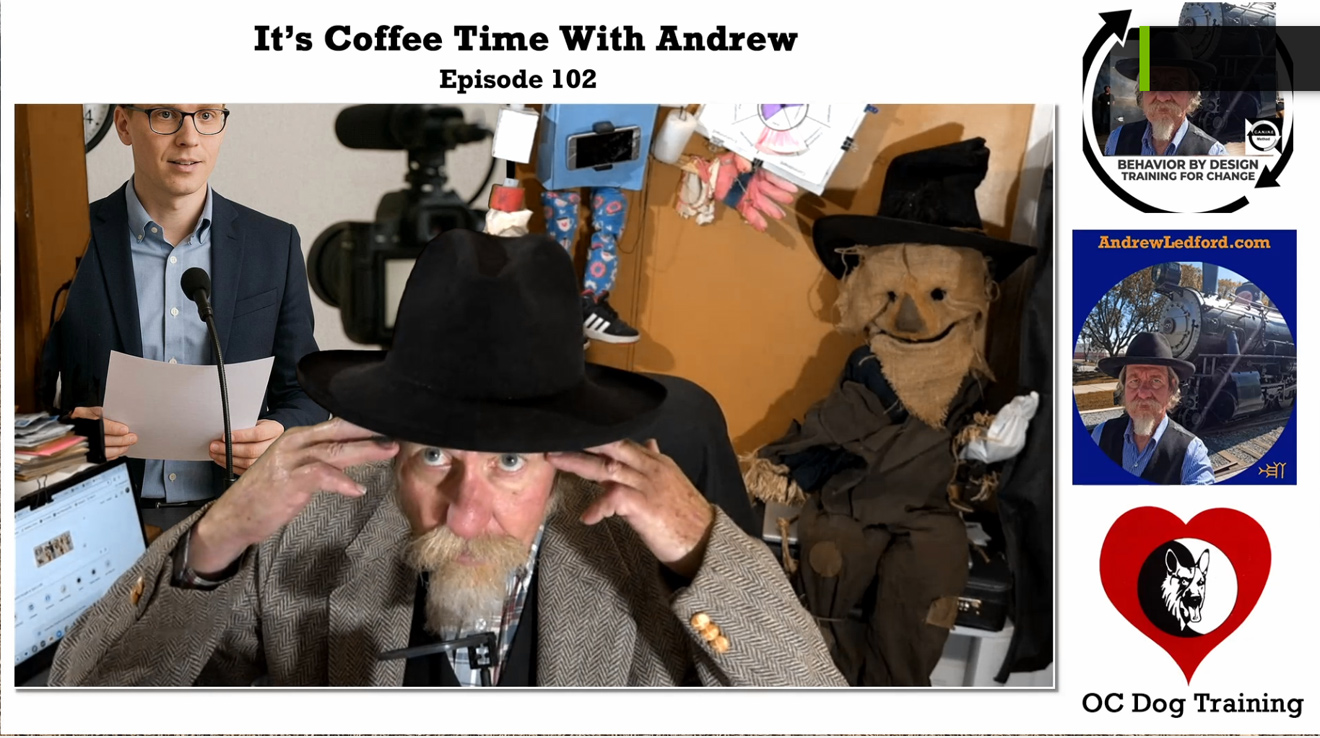
Coffee Time With Andrew 2.0 Episode 102 Tips Public Speaking
In this episode of It’s Coffee Time with Andrew we go over a few tips on public speaking.
I will go over preparation, planning, and how to move on stage along with several other useful tips.
Transcription
Why, good morning. I am Andrew Ledford and this is another episode of It’s Coffee Time with Andrew. Today we are going to be going over some tips for public speaking.(…) That’s right.
So it’s comprised of several different components.
And let me go over here. I do have a few slides here.
Probably about 5% of people are totally terrified. Freeze cannot respond at all when they are talking in front of a group.
Probably another 5% are just very uncomfortable. So that means there’s 10% of the people out there who could benefit by learning to be more confident, more comfortable speaking in front of a group.
And that is something that I work on.(…) Actually I do animal assisted emotional regulation and this is how we go over teaching people to be more comfortable and of course with a dog. So 10% of the people are quite distressed when they are speaking in front of a group and about half of those own a dog. So that means there’s a lot of people out there who I could help.
And this is something that’s kind of interesting. Have you done any public speaking in the past? And if so, how did it make you feel? And if you do want to learn to be more comfortable in front of a group, why do you want to learn? Is it for business? Is it for presenting to organizations you belong to? Do you have a non-profit that you want to go out and talk to people about? So this is something to consider and we can rate this on a hierarchy of scale actually from one totally comfortable. You can talk to anybody anywhere in front of any size group.(…) That’s a one to ten. That’s the 5% that’s terrified. They just can’t do anything in front of a group.
And you might want to consider where you are on that scale.
One of the things about speaking to people is that you need to have some commitment. If you are committed to a cause, a purpose, your message, you’ll probably do just fine talking in front of a group. At least fairly small groups, 50 people or so.
I always use this as an example because I went to this one small event. It was like a trade show. People there were vendors and weren’t public speakers. But once they got up, once they started talking about something that they were really committed to, they did just fine. A little stumbling here and there, not quite perfect, but they did good enough that it really, they pulled it off. Did quite nicely considering the situation.
Okay, so how are we going to become more comfortable in the average presentation? Well, for one thing, you want to be prepared.(…) Being prepared is probably the most important thing you can do.
In preparation, of course, that is practice.
I think I read an article that said you should practice your presentation 30 times and you will not have a problem because even if you go blank, you’re going to still say the right thing. And I think that’s probably true.
Probably I do not practice a presentation that often, but if it is a complex presentation, I do try to practice quite a bit.
The other thing to being prepared, you want to be prepared with your equipment.
Countless times, I will get up there with my computer and things just don’t work the way I would like them to. And then I’m always thankful I did a little preparation because I can sail on through without the computer, without the slideshow.
So that’s something.
And if it is a complex presentation and you have equipment problems, your computer won’t work, whatever it might be, you should have a backup.
And what I like doing is having just a little card, have everything on like a card catalog type of card.
And that is often very helpful, especially if you have rather specific information you’re trying to convey, such as a quote. So if I have a quote I want to use when I go out,(…) even if I’m using my computer, I like to have my notes with me so that something goes wrong. The battery dies. I can just reach into my pocket, pull out my notes and keep on going.
And I have had that happen before.(…) I have a very old laptop that I put Linux on and the battery just doesn’t last very long. And if I get it all ready and I’m talking,(…) sometimes it just dies. So that is something you should be prepared for.
What else? You want to make sure that you’re prepared for the amount of time you have. So if you have, and I know usually if I’m doing a real informal presentation where the time’s very loosely defined, I will tend to go over just a little bit. But ideally you want to stick to your timeframe.
And if there’s somebody out there giving me a countdown, I will stick to it much easier than if I have to just guess.
But you should prepare in a way where you know about how much time you have and about how long it takes to do the presentation.
And that can be helpful.
And then the most important part of your talk is probably going to be the opening and the closing.
And you want to have a really strong opening. And some people say you should lead with a hook, which might not be a bad idea. And I often try to come up with something clever,(…) usually something that takes one, somebody in one direction and then does a switch back to the main point. But related enough that there is some continuity there.
And then the close is important. And oftentimes that is a call to action. And we’re going to be looking at that here in a minute. I’ll be talking about that again.
What you want to do as far as your movement goes on stage is to have a home base or what I think of as a mark.
Because you want to have some place to move from and move back to.
And this gets back to, I used to train dogs for TV commercials and movies and that sort of thing. One of the first things I taught them was to go to a mark so that you could send them to a specific area and they would be on camera and do everything nicely right when they were supposed to and more importantly where they were supposed to.
So let’s take a little look at a video I have here.
Here we go.
So today we’re gonna go over three public speaking tips.
First of all, when you get up there to speak, it might be helpful if you just pause and take a deep breath before you start. (Blank Audio)
And after that, what I want to do today is go over two speaker’s triangles. We’re not gonna be talking about the rhetoric triangles, but we’re going to be talking about physical movement. And we’re going to start off with what I call the female triangle.
And this is where you’re moving up to one corner across and then back.
So you’re talking, making a point, you’re going to make a new point, you go up to one of the corners,(…) and you make a point at that area.
So then at that juncture, you move over to the other corner.
And here you make another point. And usually when I’m talking about going forward or backwards, it’s a good time to move back to your original spot.
So this is approach avoidance, I talk about that a lot. And this is your mark, this is your home base, and this is where you want to end up. And then to end the presentation though, is you’re going to walk forward and end with a strong closing. So the two most important parts to your presentation is a good opening, very strong opening, and then a strong closing, oftentimes a call to action.
The second triangle we’re going to go over is what I call the male triangle. And from here you’re making a point, you’re going to move back to one corner to make another point.
From here you’re going to cross over, make your next point,
and then back up to your mark or home base.
Pause or step forward and end with a strong ending. Usually again, if it’s a business presentation, often a call to action.(…) Okay, that’s going to do it for this little bit of the talk.(…) I’ll see you next time. Bye.
male triangle that I often talk about.
And we also went over a couple other things. You might want to take a deep breath and pause before you start and then of course the strong opening, strong start and strong finish.
So those are all important things.
Some other options there, sometimes you don’t have room to do the triangle so you’re going across in a straight line. Or you might go across and come up and do a half female triangle or small female triangle and then come over and then perhaps you need to just do some other variation on the other side.(…) So it is flexible and it’s going to, the environment you are in is going to determine how you move.
Usually I will have my video camera on when I’m doing the presentations and sometimes I want to move in a way where it’s going to make editing easier in the future when I get back and I’m putting the whole thing together.
And there are eight ways we can move and if you include the center we’re looking at the home base. If it’s the center then we’re looking at nine.(…) But you’re going to be moving on those eight angles. So forward 45 degrees to the side, 90 degrees to the side, 45 degrees back and straight back as well as forward. And then you can be in the center or you can start up at the front and move in these different directions as well.
Now getting to the actual presentation, this is part of planning. We started off talking about planning a little bit. Now we’re going to end with it as well.
So planning is where you really start to build the structure, the foundation of your talk.
We’re going to use the Deming Cycle, the Plan, Do, Study, Act Cycle.
Somebody does something right, they’re struggling, they’re struggling and they do something right. Yes, I’m going to do a little celebration, get that dopamine burst,(…) make an impact on that’s it. You got it now.
But I do think that doing the videotape with the practice is good for the study part. And then you go out and you do it.
And if you videotape your presentation too, then you can go through that cycle again.
What worked? Then evaluate it, study it, and then go back to the plan, do study act cycle all over, especially if it’s a presentation you do over and over and over again so that you get a little bit better each time.
And I have modified this slightly into what I call the plan test, evaluate act cycle.
And I just kind of like that better. Same thing, but just a little different.
Then the other thing, what’s your strategy when you’re actually up there talking to people?(…) It’s probably not going to be the in-depth plan, do study act cycle. It’s going to be a different strategy. For this, I like John Boyd’s Oodaloo, which is observe orient,(…) then decide an act.
So you observe the crowd.
You see somebody who likes what you’re saying. You say something else, you see somebody else who likes it.
So observe, I think, is an important part. And then you orient.
How does that play into what you’re doing? A bunch of people are on their cell phones.
Things probably aren’t going too good for you. You’re going to have to do something to snap them back into your narrative.
And that’s the decide part. But you have the shorter version of observe orient act. And that’s probably what you’re going to be doing a lot of when you’re actually standing up there talking to a group.
I think that’s going to do it for this coffee time. I hope this was more informative for you than some of the other ones I’ve done. If so, leave a comment if it’s on YouTube or Facebook or someplace else.
And if you enjoyed learning more than me just talking about what I’m doing in my life, just let me know and I’ll try to do more of these. I do think the next coffee time is going to be about two books I read. That was supposed to be this one, but then I started thinking that’s always a dangerous thing. And I thought, you know, maybe I’ll do a little bit more educational presentation this time.
That’s going to do it for me. I am wishing you the very best in life. Have a wonderful day. Bye bye.